
Could the Bluetti Elite 300 Be the Off-Grid Setup We've Been Looking For?
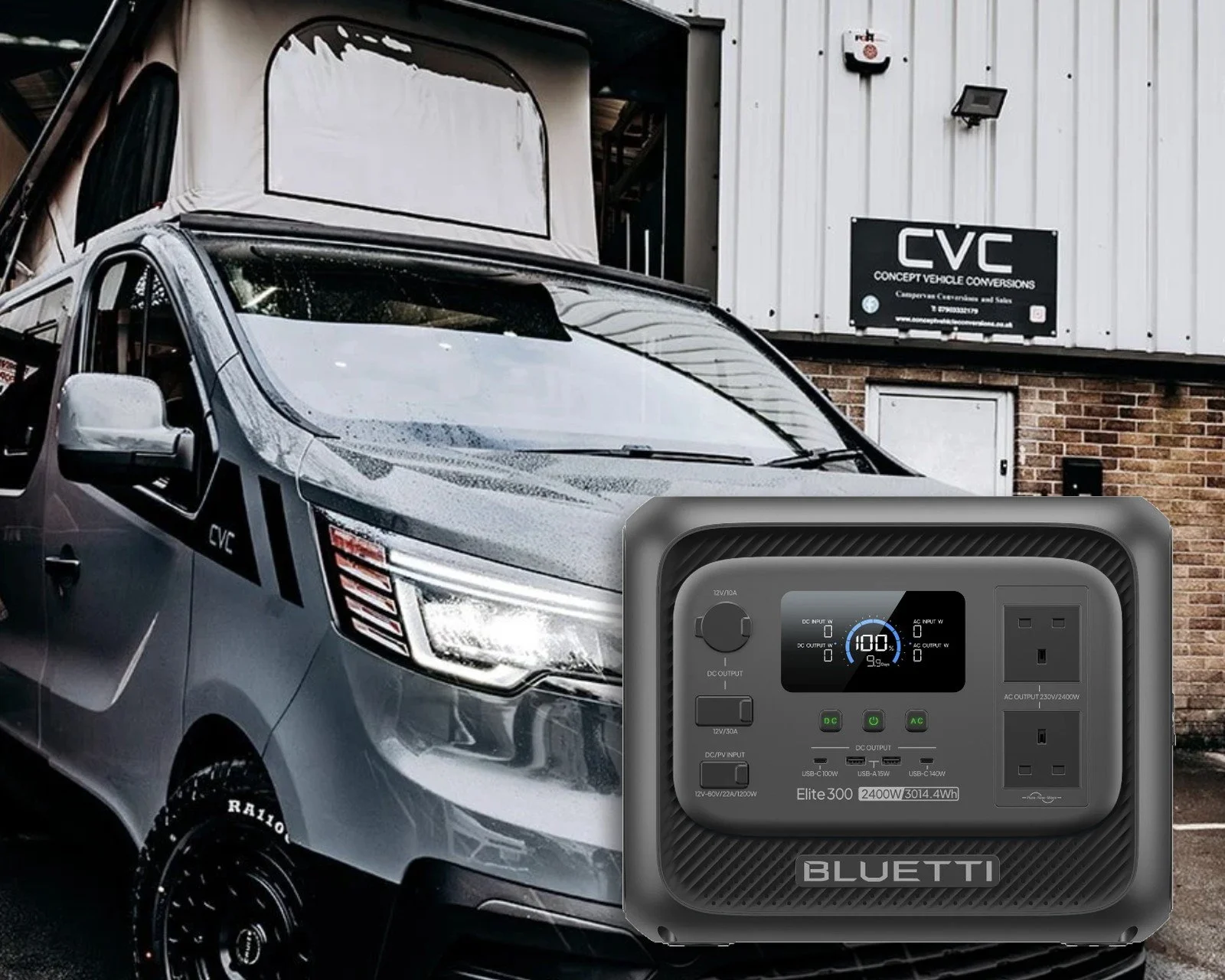
We've been keeping an eye on portable power stations for a while now, and one has landed on the bench that's got us talking. The Bluetti Elite 300. On paper it's a serious bit of kit, and we've started wondering whether pairing one with a solar panel and a DC-to-DC alternator charger could be the off-grid setup a lot of our customers have been asking for. Here's where our heads are at.
What is the Elite 300, in plain English?
It's a self-contained power station. Think of it as a big battery, an inverter and a charge controller all in one box, ready to plug into. The headline numbers are 3,014Wh of storage (just over 3kWh) and a 2,400W output, with a 4,800W surge for things that draw a big gulp when they kick in.
That 2,400W matters. It's enough to run an induction hob, a kettle, or a small coffee machine, the things people usually assume you can't do off-grid. The battery is LiFePO4, rated for 6,000+ charge cycles, so it's built to last years rather than seasons. It weighs 26.3kg and measures roughly 366 x 305 x 298mm, which is genuinely compact for 3kWh. There's also a 10ms UPS switchover, so if the mains drops the kit barely notices.
For ports you get two AC sockets, a 12V/30A output, USB-C up to 140W, a couple of USB-A, and a 120W cigarette socket. Plenty for a weekend away.
Why pair it with solar and an alternator charger?
A power station on its own is great until it's flat. The clever part is how you keep it topped up while you're away from a hook-up.
The Elite 300 takes up to 1,200W of solar through its built-in MPPT controller, so a roof panel could trickle it back up through the day while you're parked at the beach or up a hillside. Full charge from solar alone comes in around four hours in good conditions. That's the lazy, free, quiet way to stay charged.
The second piece is charging on the move. A DC-to-DC charger (a B2B charger) pulls power from the van's alternator while you drive and feeds it into your battery setup. This is the bit we've now tested ourselves, and it's the part that's got us properly excited. We ran the Charger 2 into the Elite 300 and it reliably pushed 800W into the unit while driving. That's not a spec-sheet guess, that's what we measured on the bench.
Put that next to the solar and the maths gets interesting. At 800W from the alternator you're putting a serious dent in a 3kWh battery on a normal drive, and the roof panel holds it there once you've parked up. For couples doing long touring trips, that combination could mean rarely needing a hook-up at all.
How does this compare to a normal leisure battery install?
This is the real question. Our standard builds use a fixed leisure battery, a charger and an inverter, all wired in and hidden away. It's neat, it's permanent, and it's what most people picture in a camper.
A power station is a different philosophy. The upsides are real. It's plug-and-play, so there's far less wiring buried behind panels. You get a big inverter and 3kWh in one unit. And because it lifts out, you can take it into a tent, use it at home in a power cut, or pull it out over winter for security. The 6,000-cycle battery and Bluetti's own warranty add to the appeal.
The trade-offs are just as real. It's 26kg of box that needs a proper home and secure mounting, because anything that heavy has to be held down safely for crash protection.
But the big one, the trade-off we keep coming back to, is what happens if it breaks. With a power station, the battery, the inverter and the charge controller all live in one box. If that box fails, the whole system goes down at once. With a traditional setup, every part is separate, so if your inverter packs in you swap the inverter and carry on. One unit means one point of failure, and that's worth being straight about.
We're not guessing on this, either. One of us has been running the bigger Apex 300 in their own camper for a good while now, and the truth is it's been brilliant. It just works. Day after day, trip after trip. So the single-box worry is real on paper, but our own experience of living with one has been genuinely positive.
So, would we actually fit one?
So here's the real talking point. A traditional install wins on repairability, no question. If something fails you replace the one part and you're away. But look at what the power station gives you in return: a full 240V mains supply, off-grid, from a box small enough to lift out with one hand. Run the kettle, the induction hob, charge the laptops, all without a hook-up in sight, in a footprint that frees up space a fixed inverter-and-battery bank would swallow. The question we keep asking ourselves is whether that size and that capability outweigh the one-box risk. For us, after living with the Apex 300 and now testing the Elite 300 charging at 800W off the alternator, we're leaning towards yes.
We're not there for every build. Someone who tours for weeks at a time in remote spots might still want the redundancy of separate parts they can fix on the road. But for a lot of our customers, the simplicity, the space saving and being able to run proper 240V anywhere is a genuinely tempting trade. We can already see this becoming an option we offer alongside the traditional fixed install, picked to suit how each customer actually uses their van.
If you've got a thought on this, or you're weighing up off-grid power for your own build, drop us a message or comment on our Facebook post. We'd love to hear what you'd want in your setup, and whether a power station or a fixed install suits how you'd use it.
